Garage Door Spring Repair in Richmond, IN
Spring repair around Richmond means a replacement spring sized to the weight of your particular door, with the door brought back into balance so the opener only has to guide it.
Heard a sharp bang in the garage and now the door refuses to rise, or rises an inch or two and halts? A spring has probably failed. Leave the door closed until you've read the rest.
Telltale signs of a snap
A bang as loud as a gunshot, often when no one is using the door. Torsion springs are most stressed with the door down, which is why so many choose that moment to give out, with nobody near.
A break in the coil
Look at the shaft above the shut door: a broken torsion spring leaves a clean gap, sometimes a few inches wide.
It suddenly weighs a ton, or won't stay up when you raise it by hand.
The motor buzzes and strains, or nudges the door up an inch or two
Many openers detect the extra load and give up, so the motor gets blamed for a spring's failure.
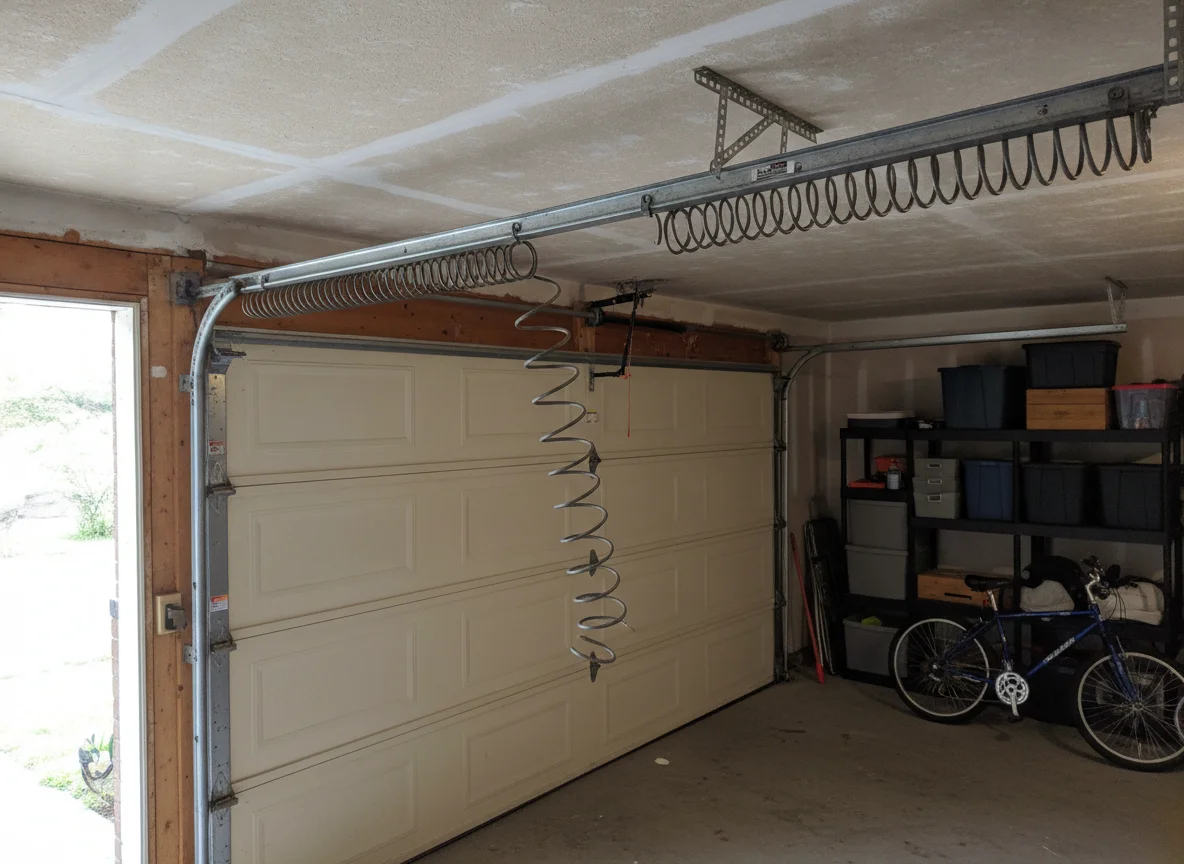
The door rises askew, one corner ahead of the other. Where a spring runs along each track, one may have gone slack.
The door drops hard through its last foot of travel instead of settling.
Bang in the garage, then a door that won't lift? Leave it closed and tell us what you see overhead.
Contact UsStaying safe meanwhile
A wound spring holds enough energy to break bones, and when one has failed the door's full weight rests on whatever else is holding it up. Until it is repaired:
Resist forcing it open by hand or hammering the wall switch again
Opener motors aren't designed to bear that load, and mashing the button can chew up the gear.
Don't release the opener when the door is raised
Without a spring, nothing stops it falling at full weight.
Don't touch the tension on a torsion spring bar
Stored energy sits in the winding cones, and they are behind the trade's most serious injuries.
Send children and animals away from the door, and park elsewhere if it has stalled partway open.
Tell us up front if a vehicle is trapped in the garage.
Torsion versus extension springs
Torsion springs ride on a shaft above the door, twisting to hold energy and turning drums that reel in the lift cables.
These suit most doors made in recent decades. They raise a door more smoothly than extension springs do, and they fail more safely since a broken spring stays on its shaft.
Extension springs are the ones stretched along the side tracks, extending as the door comes down. You find them mostly on older, lighter doors. Every one needs a safety cable through its center, otherwise a breaking spring can whip across the garage.
A spring with no cable through it should get one even before it breaks.
Older extension-spring doors can generally be converted to torsion, and with Richmond's median home dating to 1957, it's a fair thing to ask about.
How a spring job unfolds
Step one: measure the spring that failed
Wire gauge, inside diameter, length and winding direction all count, and a wrong guess leaves the door out of balance.
The weight of the door is considered
The right spring is chosen for your door's weight, not for being the closest one in stock.
The old spring is removed with tension controlled, released before any bolt is loosened.
The replacement goes in and is wound or hooked up; cables are inspected at the drums so each side lifts equally.
Balance gets verified at the end
Disconnect the opener and the door should hover about where you leave it at waist level, then cycle cleanly under the opener.
Describe the door's behavior
A couple of lines will do. Don't worry about the name of the part that failed; say what's happening.
One spring, or two?
Two springs share the load and the cycles equally. Once one fails, its partner is typically right behind it, so the other deserves suspicion.
Replacing the pair together saves a second trip and keeps the door level, because a new spring pulling beside an old one tugs unevenly.
Ask what they recommend for your particular door, and why. If yours has a single spring, ask whether two springs would lift the door better.
Spring repair cost: the main factors
Spring type, plus one spring or two on a torsion door.
Size and weight of the door
Double doors, solid wood and insulated steel all call for heavier springs than a light single door.
Spring cycle rating
A spring is built to survive a set count of open-and-close cycles. Higher counts cost more yet outlast lower ones on a door that cycles many times daily.
Other worn parts
Frayed cable ends at the drums, dragging rollers, or tired bearings on the torsion shaft cost less to swap on the same trip, since the door is already apart.
Converting from extension to torsion, should you choose to.
What lifespan can springs expect?
Cycles count for more than years. A spring with a set cycle rating will outlast the same one on a door that's the main family entry by a wide margin when the door only opens a few times a day.
Cold makes spring steel brittle, and with a record low of -27 F in Richmond, many springs go on the first freezing mornings.
Springs that failed sooner than expected? Ask about one with a higher cycle rating.
The cost gap is usually small compared with a second repair.
When the spring is fine
Spring looks whole, but the door sags to one side or a cable hangs slack
Read garage door cable repair.
No breakage, just a sluggish or noisy door
A maintenance visit examines springs ahead of any failure.
Quick answers
Can a homeowner swap out a broken spring?
Extension springs are a task some homeowners handle, once safety cables are on and the door is propped fully open and clamped.
Torsion springs are a different story. Winding calls for proper bars plus the precise spring for your door, and one slip dumps the stored energy into your hands. This is the repair where hiring out is as much about safety as about convenience.
Is there a safe way to get my car out?
No; with a spring broken the door isn't safe to open. Leave it shut and mention the car.
What made my spring give way when the door sat idle?
A spring tires with every cycle, and a torsion spring sits under its greatest twist while the door is down. The last strand often lets go in that state, helped along by cold, which stiffens steel. It doesn't mean anything else is wrong.
Is a new opener needed with the spring?
Seldom. If the opener spent days fighting a broken spring, though, it's worth checking that its gears haven't stripped.
Related garage door work
Garage Door Cable Repair
Lift cables that frayed, broke or slipped, and doors sitting crooked.
Read more →Garage Door Opener Repair
Openers that hum, back up or ignore the remote, and new units when repair isn't worthwhile.
Read more →Garage Door Maintenance
A tune-up covering springs, cables, rollers and the reversing test before anything gives way.
Read more →Reach out
Single or double door? Say what you heard, whether anything moves, and if a car is stuck inside.
A floor-level photo of the spring helps. Indiana expects written contracts on most jobs, per the Indiana Attorney General Consumer Protection Division.